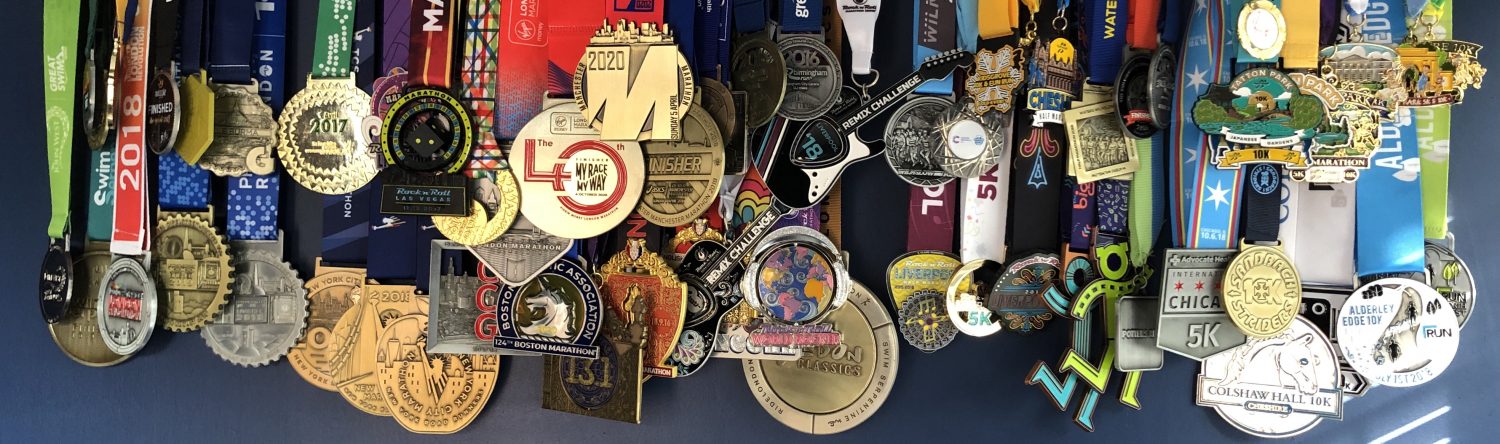

It has been a while since I last posted a rundown of my running race day gear, in fact, it was 3 years ago at the 2019 New York City Marathon so it has been cool to have a look through the gear from 3 years ago and compare it to this year. There is actually very little difference besides different colour Next%’s and a different singlet and shorts but in essence, it’s the same kinda stuff which goes to show, as runners we are creatures of habit. Find what works for you and stick with it.
The main difference between my runnings of 2017, 2018, and 2019 New York City Marathons and this year is going to be the weather. Those years were 13’c, 11’c and 11’c. This year is forecast to be 20’c at 6am and peak at 23/24’c.
At the New York City Marathon the trip to the start and wait at the start villages is as legendary as the race itself. The start is on Staten Island and to get there you have to either take the bus or the ferry and it is early! like 5:30am – 7am early, you can spend around 2-3 hours waiting at the start villages, most years you are waiting in some really cold conditions. This is where the main difference in gear will be for me this year.
All other years I have gone to the start wearing old throw-away joggers, hoodies and jackets. I have raced in beanies, gloves, long-sleeved tops or arm warmers. This year with the weather being so much warmer I will most likely travel to the start in just my race shorts and singlet.
It does make you think though. New York Road Runners collect all those throw-away clothes and donate them to charities in the tri-state area. With this warmer weather, you have got to imagine that the amount of clothes left behind is going to be significantly less than normal meaning fewer donated to charity.
As with previous gear posts, I will split this out into nutrition/fuelling and the actual race gear.
Nutrition
The big rule that you must follow on race day is “Nothing new on race day”. Now, you probably can get away with trying some new clothes on race day, maybe even a new pair of shoes but you are risking it. One thing you certainly shouldn’t break that rule with is nutrition, especially over the marathon distance. Break that rule and you could be in for a pretty shitty race… literally.
So, goes without saying, all of the nutrition I am using for New York City are items I have used during training and racing throughout the year and long in some cases.
Pre Race:
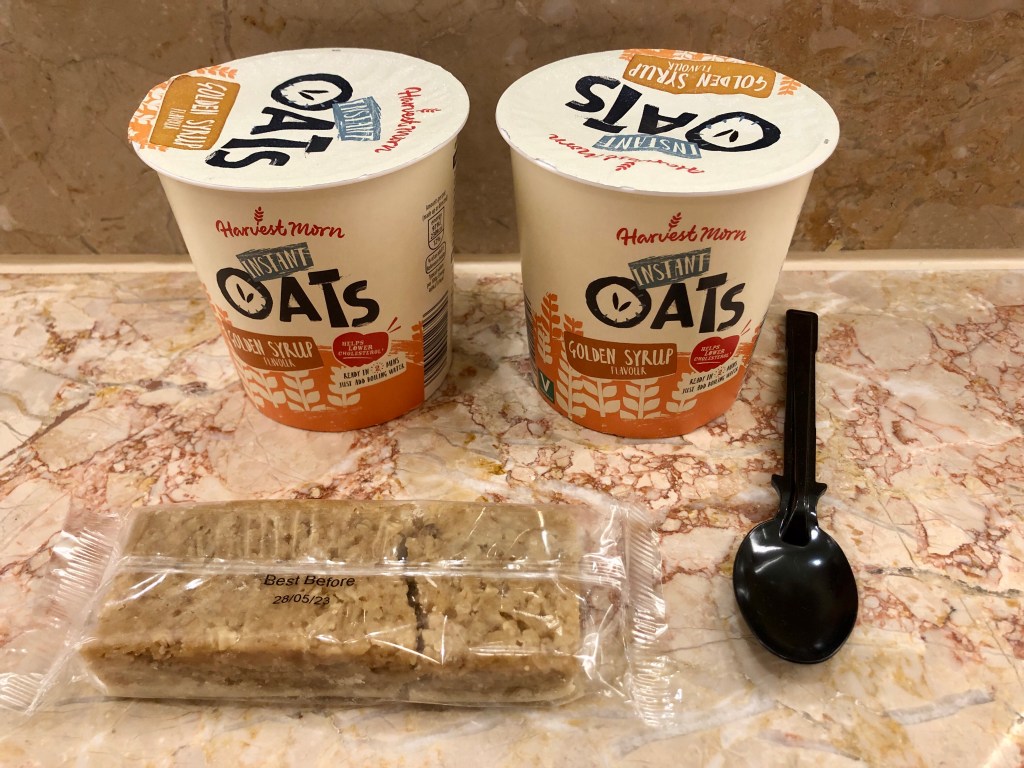
My go-to race day or big training day breakfast is porridge oats. At home, I would have a bowl around 1 hour before a long training run. When I travel for races I take two of these Harvest Morn Instant Oaks, the golden syrup ones are my favourite.
New York City is a little bit different. As mentioned above, I will be leaving the hotel around 4 hours before the gun goes off which means if I ate breakfast before leaving the hotel, I will most definitely be feeling hungry by the time the race starts.
The team at NYRR have taken this into consideration, at the start villages they have Dunkin their to provide cold water, hot water, tea, coffee, hot chocolate, fruit and bagels. So what I do is pack the two porridge pots in my start village bag then about an hour before the race start, I mix these up with the hot water and have my go-to breakfast right there at the start village. I also take a flapjack to eat sorta like a first breakfast on the bus to the start.
Race:
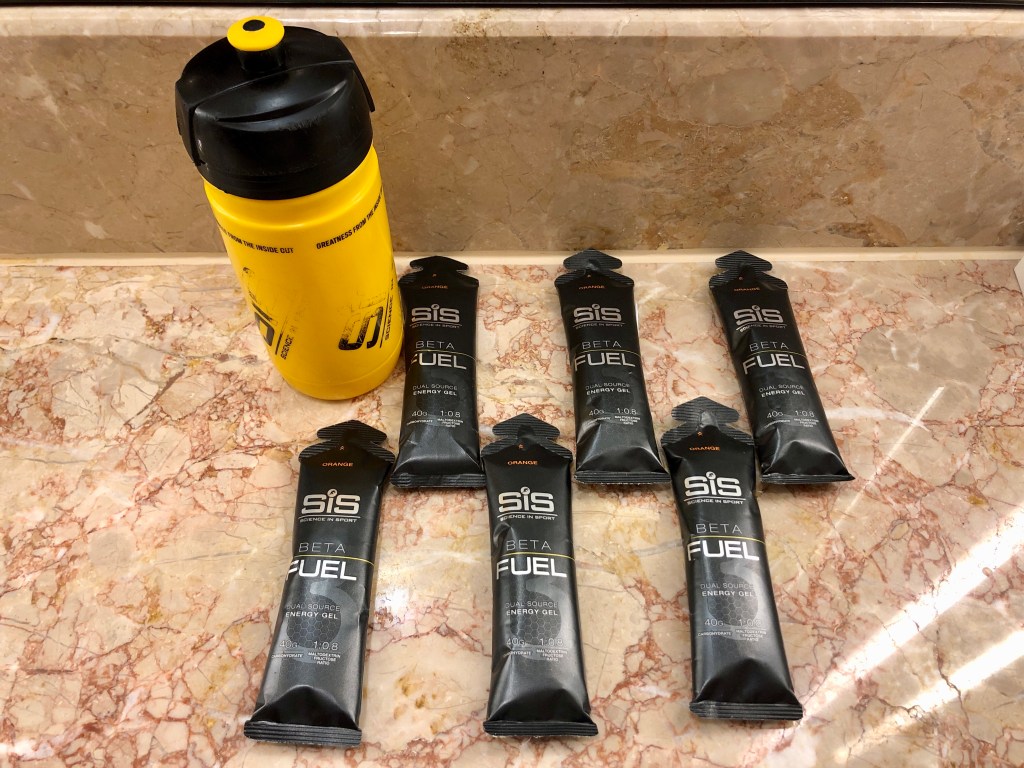
During the race itself, I will carry 6 or 7 Science in Sport BetaFuel gels (Orange flavour). I like to take a gel every 30 minutes, so 6 gels should be good for 3hrs 30min or 7 for 4 hours. I have swapped to the SiS BetaFuel from Maurten Gel 100 this year and I haven’t seen or felt any drop-off in comparison. For me, the big driver behind that change was the cost of the Maurten Gels, they are fantastic but they just cost so much money. Don’t get me wrong, the BetaFuel isn’t cheap either but you get more gels for less money and without feeling any drop off in performance, it’s a no-brainer. For me, it may be different for you.
I used to use distance as a guide for when to take a gel or fuel the body, say a gel every 4 miles. One thing an experienced endurance runner told me very early on what that the body has no concept of distance, it doesn’t burn x amount of carbs or fat per mile, it is all per hour. A more efficient way to ensure the body has what it needs is to fuel based on time, such as a gel every 30 minutes. This is something I have used for years and have found it to work well for me. Again, every person and every body is different.
This year, with the forecast for warmer and more humid weather, alongside the SiS Gels, I will be carrying a 500ml bottle of water mixed with 1 and a half scoops of SiS Electralyte powder. I will sip on this during the race to help with the hydration. This is the bottle I carry on all of my long runs at home, it usually lasts 14-16 miles. I think with tomorrow being warmer and high humidity, I will get through that bottle by halfway.
From there on I will be hitting the aid stations, my plan is to grab water from the first half then a Gatorade from the second half of each aid station which are roughly located at each mile marker, barring some of the earlier miles.
In warm humid weather, staying on top of your hydration and nutrition is one of the key factors to a successful race. Make a plan and stick to it. Don’t be tempted early on to think you feel good so you will skip an aid station, that will come back to kick you later on.
Race Day Gear:
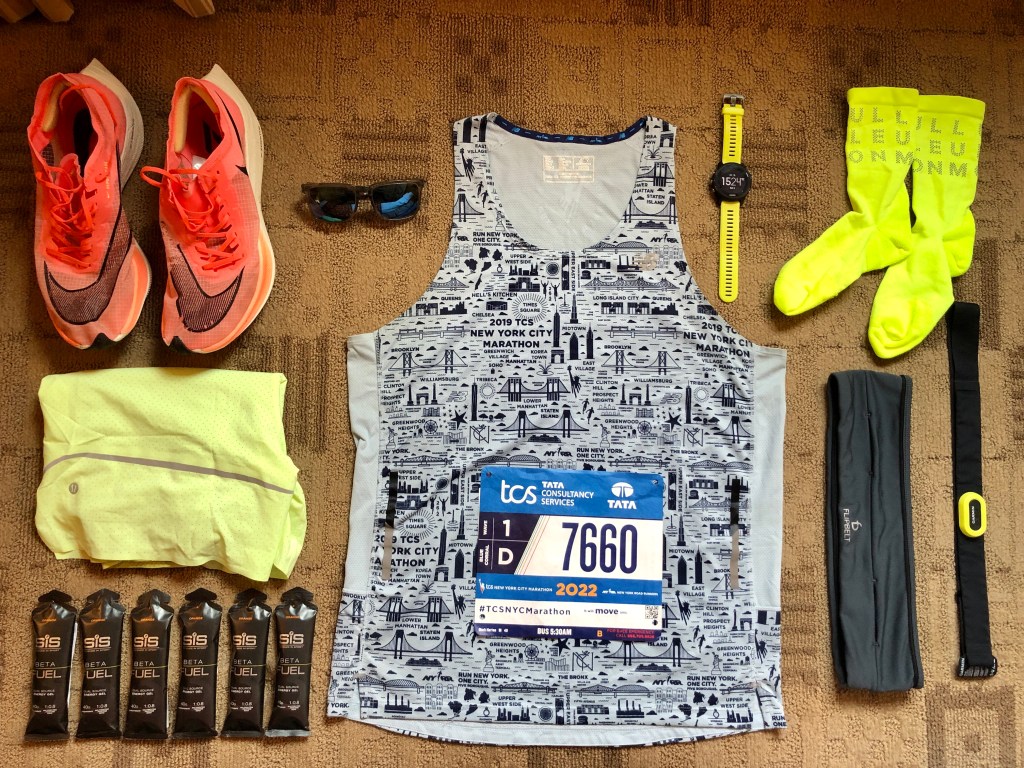
The race day gear, the more interesting stuff to most people.
We’ll go top-down and start with the one thing I missed in this photo, the running cap. This year I will wear the Nike AeroBill Tailwind running cap, this hat isn’t new, I have worn this for most races since 2018. It really has stood up to everything I throw at it. This year it will come in handy for keeping the sun out of my eyes, off my face and wicking some of the sweat off my head stopping it from running down my face.
Next, I have the Roka Kona sunglasses, again, I have had these for years and run all road and triathlon races in them, mainly because my race photos always look better when I have sunglasses hiding the pain.
My running singlet this year will be the 2019 New York City Marathon new balance singlet. This is by far my favourite running singlet, it has all the bridges and neighbourhoods we will run through and all of the major sights we will see, it’s just so cool. It is very lightweight and cool, perfect for those long hot summer training runs and perfect for a hot and humid marathon.
Under the singlet, I will have the Garmin HRM Pro to track my heart rate. Although I can tell you now, that is one metric I won’t stress too much over tomorrow. It is warm and it is humid so that heart rate is going to be higher than normal, I have adjusted my pace and goals accordingly.
Also under the singlet is the FlipBelt, I will pack 4 of the Sis BetaFuel gels in this belt and the other 2/3 in pockets in my shorts.
Speaking of which, my shorts are the Lululemon Surge Lined 6″ Shorts, I am not gonna lie, these are easily the most comfortable shorts I have run in, they are expensive but I love them. This will be the first time I have raced in them but I have a feeling these will be my go-to race-day shorts after tomorrow.
My watch is the Garmin Forerunner 935, a multisport watch that is now a couple of iterations old. It doesn’t track elevation or temperature now, well that’s a lie, it does track some sort of elevation but it’s certainly not the elevation I have run. Take today’s Abbott Dash to the Finish as an example, my watch recorded 2,300ft of elevation gain when in reality, it was 115ft. It does the core tasks of tracking distance, pace and pulling heart rate data from the chest strap. I really do need to replace this though.
Socks are also by Lululemon, really soft and comfortable tight-fitting socks. They feel great for running in and like the shorts, could be the go-to race-day socks. They match the shorts so if the shorts are the go-to race-day shorts then I have no choice, right?
That just leaves the shoes. Nike Vaporfly Next%. The fact I am still racing in Next% 1 shoes from 3 years ago sums up how little road running I have done over the past 3 years. Given the choice, I would still buy these shoes for any marathon (on the road). The high stack height can sometimes pose a challenge on a twisty course but for New York’s long straight avenues this is ideal. That stack height and cushioning just babysit the legs throughout the 26.2 miles. They absorb a lot of the impact from striking the hard road surface, the carbon footplate then turns that impact into an energy return, snaping your foot up and onwards.
I love them and I am very reluctant to look elsewhere whilst these shoes still have plenty of miles in them.
 The Cheshire Runner.
One thought on “NEW YORK CITY MARATHON 2022 GEAR”