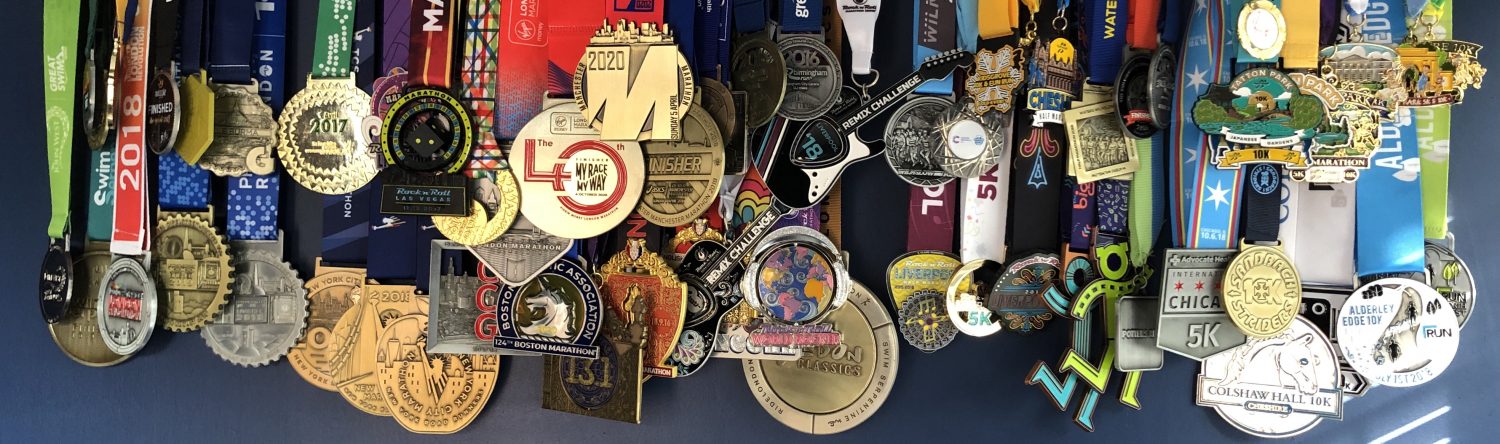

This is a quick run through of the shoes I have or planned to run in during 2020.
Until I pulled them all together for this post I didn’t think I had used that many shoes, oops. It also appears I have a Nike problem too.
Let me know what shoes you have been running in during 2020, there are soooo many to choose from out there.
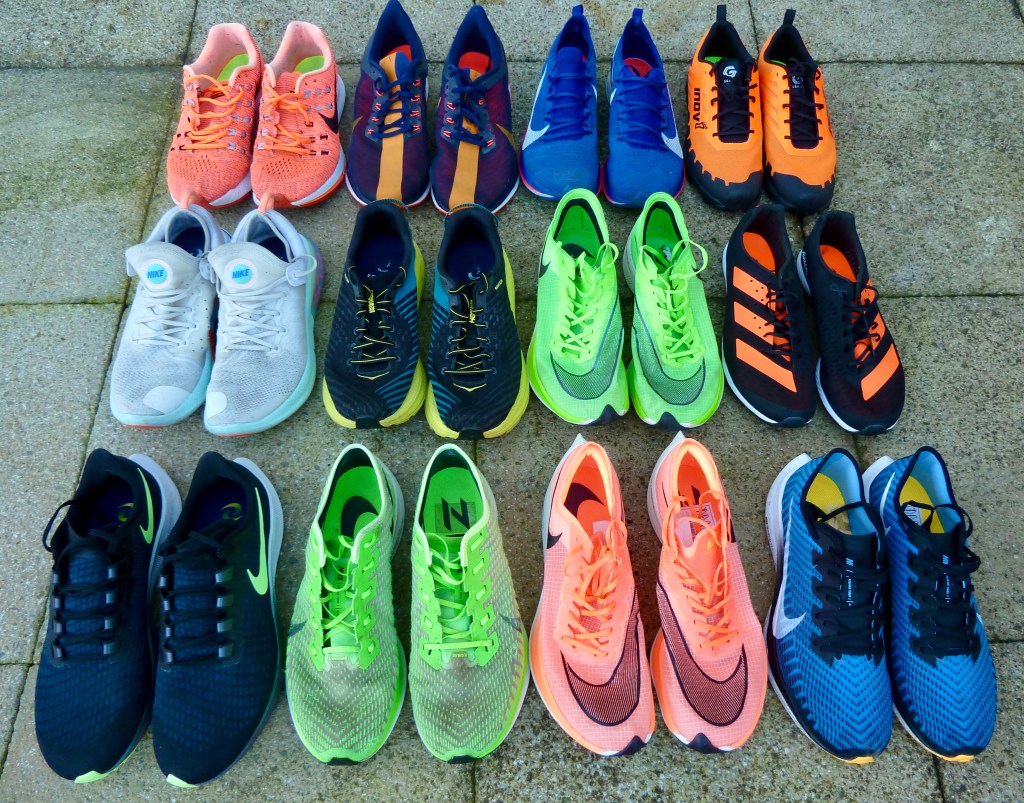
I am fortunate enough to be able to get a pair of shoes for different types of run. I like to have an easy run shoe, I like to use one shoe for my tempo and medium – long runs and then have my race day shoes, which let’s face it, these did not see much action in 2020. I also have shoes for cross country and trail running.
There are 10 pairs of road running shoes pictured above but if I was only able to buy one shoe I would pick the Nike Air Zoom Pegasus 37. This is a great all-rounder that can be used as a daily trainer, easy and steady runs and long runs. It wouldn’t be the best for tempo sessions but it wouldn’t be the worst shoe.
Some of these shoes have carried over from 2019, one pair is actually from 2017! I have managed to get good mileage out of the shoes which I have now retired and I have included the mileage as well as a photo of the wear on all shoes below.
Easy Day Shoes:

For my easy runs, I like to have a shoe with decent cushioning and support to give the feet and legs some time to recover from those tough sessions. I am not fussed about the weight for these runs. The pace tends to be 2 – 3 minutes slower than marathon pace and easy runs make up roughly 66% of my weekly runs.
Nike Air Zoom Structure 19 – 632 Miles (Retired)

This is the pair from 2017 which I took to 320 miles then decided they had run their course before pulling them out of retirement at the beginning of this year.
They are a good hard-wearing shoe that just keeps going so I was able to get a further 300 miles out of them and to be honest, the wear isn’t that bad for a shoe that has covered 632 miles. Only the lugs under the ball of my foot have worn down.
I originally brought the structures as they are as the name suggests, a shoe that is structured and supports your feet.
I am someone who overpronates, meaning my natural footstrike lands on the inner edge of the shoe and I also have low arches.
Both of these issues lend toward a more supportive shoe. In the early days, I went for this structured shoe but from 2018 onwards, I have been using Enertor Running Insoles to help support my foot. These have meant I can switch to a more neutral shoe, such as all of the shoes listed from this point on.
Nike Joyride Run Flyknit – 337 Miles
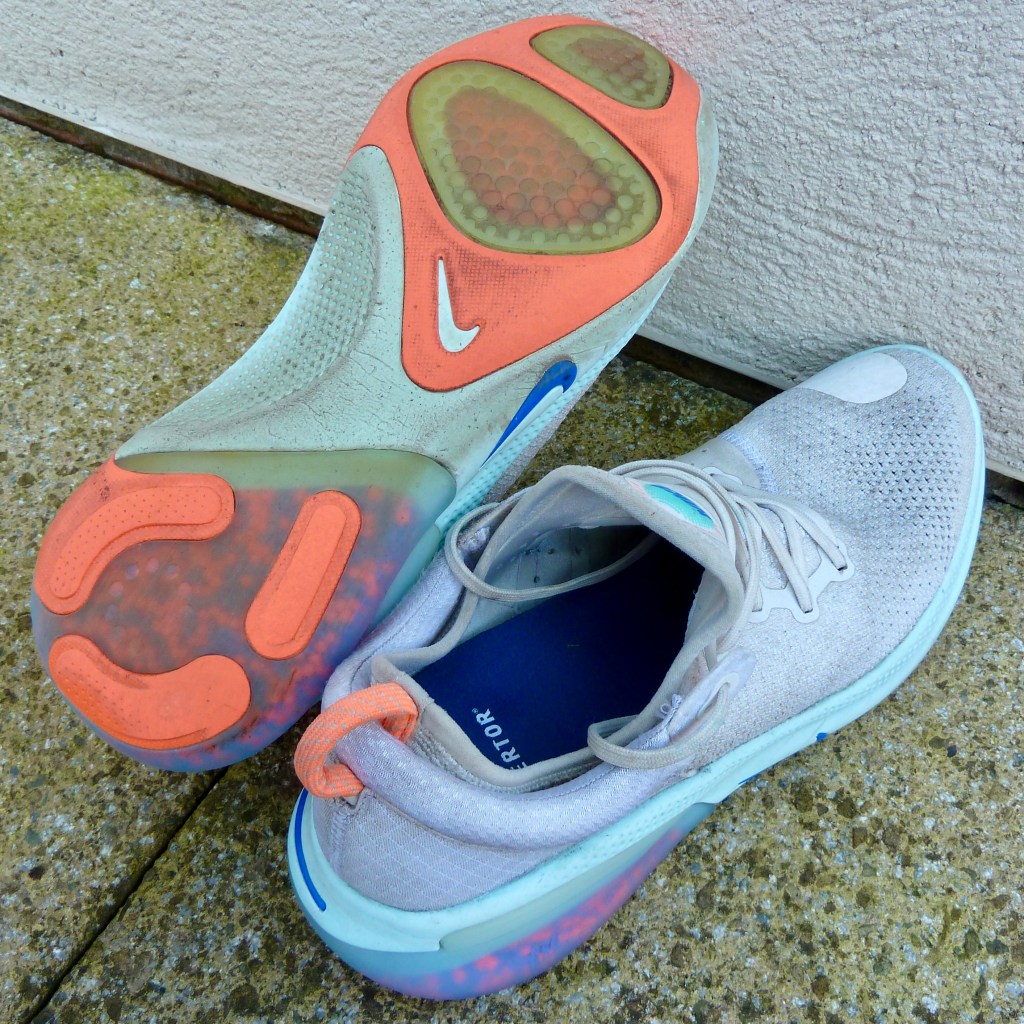
Nike brought the Joyrides out this year and marketed them as an easy run shoe. They are filled with thousands of little beads which mould around your foot as you run. They are supposed to reduce the impact of the foot strike and reduce the stress on your feet and legs, basically everything you would want from an easy day shoe.
I got these on release day to try them out and at first, I wasn’t really a fan. It took a few runs to get used to the feeling of the beads in the shoe and I guess it also took a few runs for those beads to mould around my foot too. Since then I have enjoyed running in these.
They are a heavy shoe and don’t offer much if any energy return but for a slow easy pace, they feel great.
As these are white shoes, I used them during the dry summer months but have not run in them since we moved into the wet & muddy autumn & winter months.
Nike Air Zoom Pegasus 37 – 96 Miles

The Nike Pegs are the best all-round shoe in my opinion and perfect for someone looking to just buy one shoe to cover all occasions. The Pegasus 37 is no exception, once again it met all my needs for an easy day shoe. It has a good stack height to give ample cushioning for those easy miles, the tread is mostly rubber so it should have a good lifespan.
It isn’t a lightweight shoe but by no means a heavy shoe, as I say, it’s a great all-rounder so it fits the middle ground.
I have used this shoe on easy runs and on medium – long runs where I am just spending time on my feet rather than pushing a pace.
Tempo & Long Run Shoes:
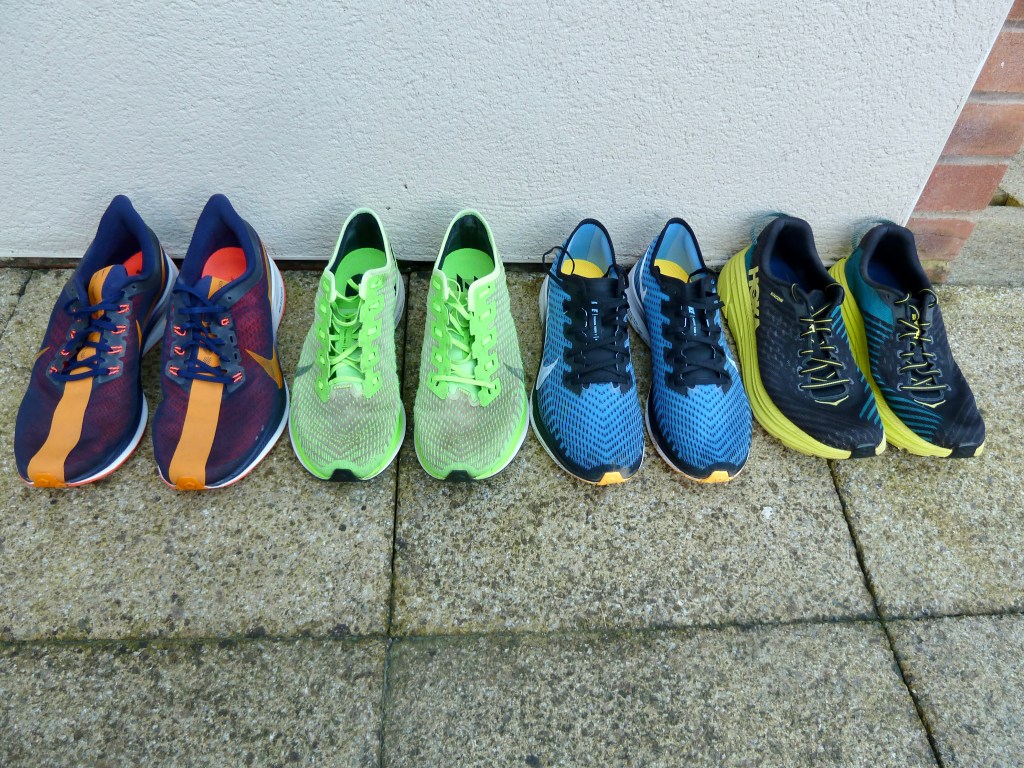
I like to use the same shoe for tempo and long runs but don’t use a carbon fibre plate shoe for any of my training runs. I save that treat for race day.
The reason I combine tempo and long runs is purely to reduce the need for yet another type of running shoe. Having 3 types of road running shoe in the rotation is more than sufficient for me.
As you can tell from the photo above, I LOVE the Nike Pegasus Turbo shoe for this task.
As this is a tempo shoe, I want a shoe with good energy return and also lightweight, the weight also comes into the long run decision as well. I don’t want to lug a heavy shoe around a 22 – 24 mile marathon training run.
Nike Zoom Pegasus 35 Turbo – 606 Miles (Retired)

I brought this pair in the build-up to the Chicago Marathon in 2018 but didn’t start running in them until partway through my training for the Tokyo Marathon in early 2019. I was instantly a fan. I remember thinking on that first run that these shoes were making me run faster but not feeling like I was putting as much effort in.
The snappy energy return is fantastic for a tempo run and being a lightweight shoe really does help on both the fast and long sessions. This shoe was billed as the training shoe to the more racy Nike Vaporfly 4% so I tried it on my long runs for Tokyo and it felt comfortable and not too heavy.
I have seen a lot of photos were the rubber on the sole has started to split but I haven’t had this issue and have in fact been able to over 600 miles in them with only a small amount of wear on the outer edge where my over pronated feet land.
I am sure the midsole foam is probably not in the best of condition after 600 miles but it did the job.
Nike Zoom Pegasus Turbo 2 – 553 Miles

I brought the Pegasus Turbo 2 in early 2019, more or less on release day. I loved the original Pegasus 35 Turbo that much I had to get the latest iteration.
I wasn’t disappointed, I probably do prefer the original shoe but still love the Turbo 2. It is slightly lighter than the Turbo and still has that same snappy feel about it and again has covered a lot of miles in 2019 and 2020. I am in two minds whether to retire this shoe now at 553 miles or eke out a few more miles.
Nike Zoom Pegasus Turbo 2 – 0 Miles
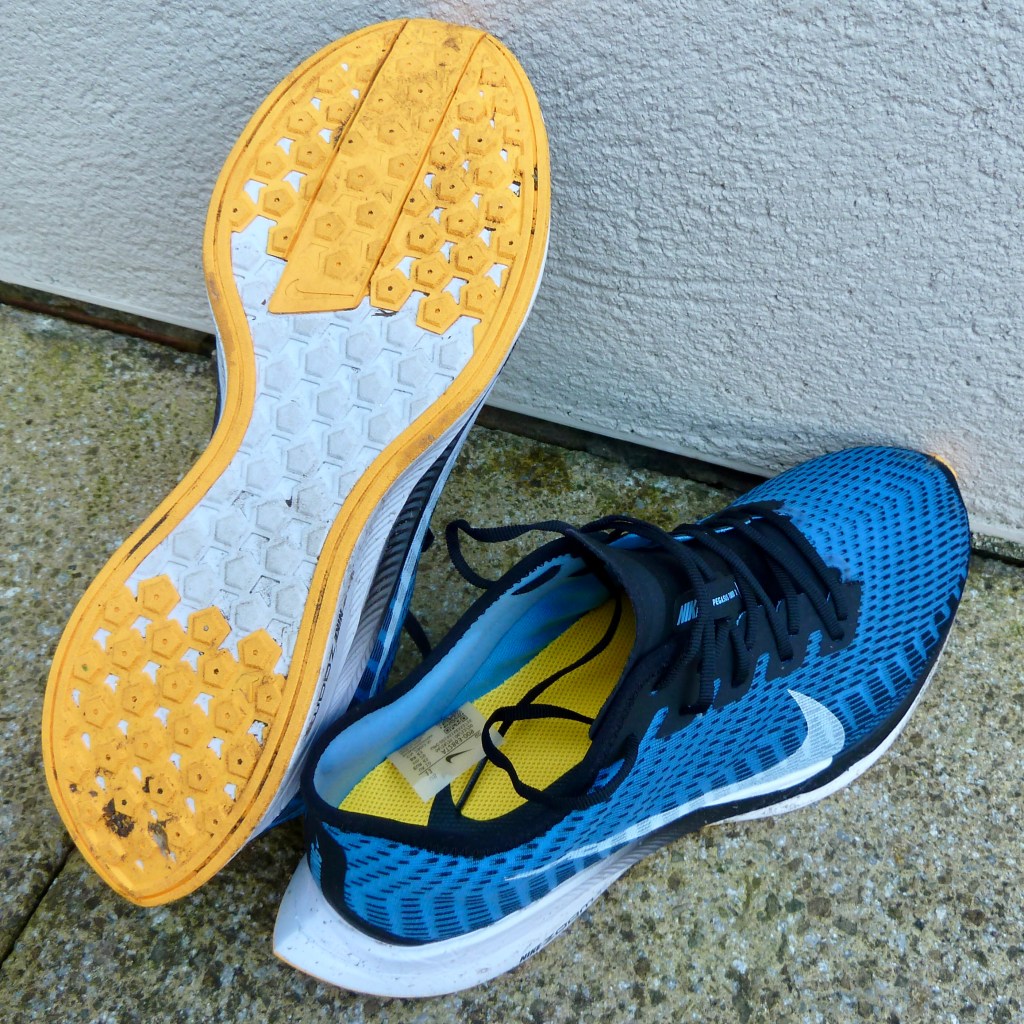
In October I brought a new pair of Turbo 2 before Nike stop selling them. They have not released a “Turbo 3”, instead, they have swapped over to the Nike Air Zoom Tempo Next%. I have heard a lot of bad reviews about the new Tempo Next% and did not want to risk missing out on a pair of Turbo 2 for my next training cycle.
Since I brought these I have been out with an injury that is looking likely to keep me out for the next 3 – 6 months so I think it was a good decision getting these whilst I could and hopefully Nike will bring out something better than the Tempo Next%.
I know this section isn’t about the Nike Tempo Next% but my reasoning for not wanting to move onto that shoe is because it is 3oz heavier than the Turbo 2, it has a 10mm drop which, for me, is too big for a training shoe. A drop that big is something I would want for race day.
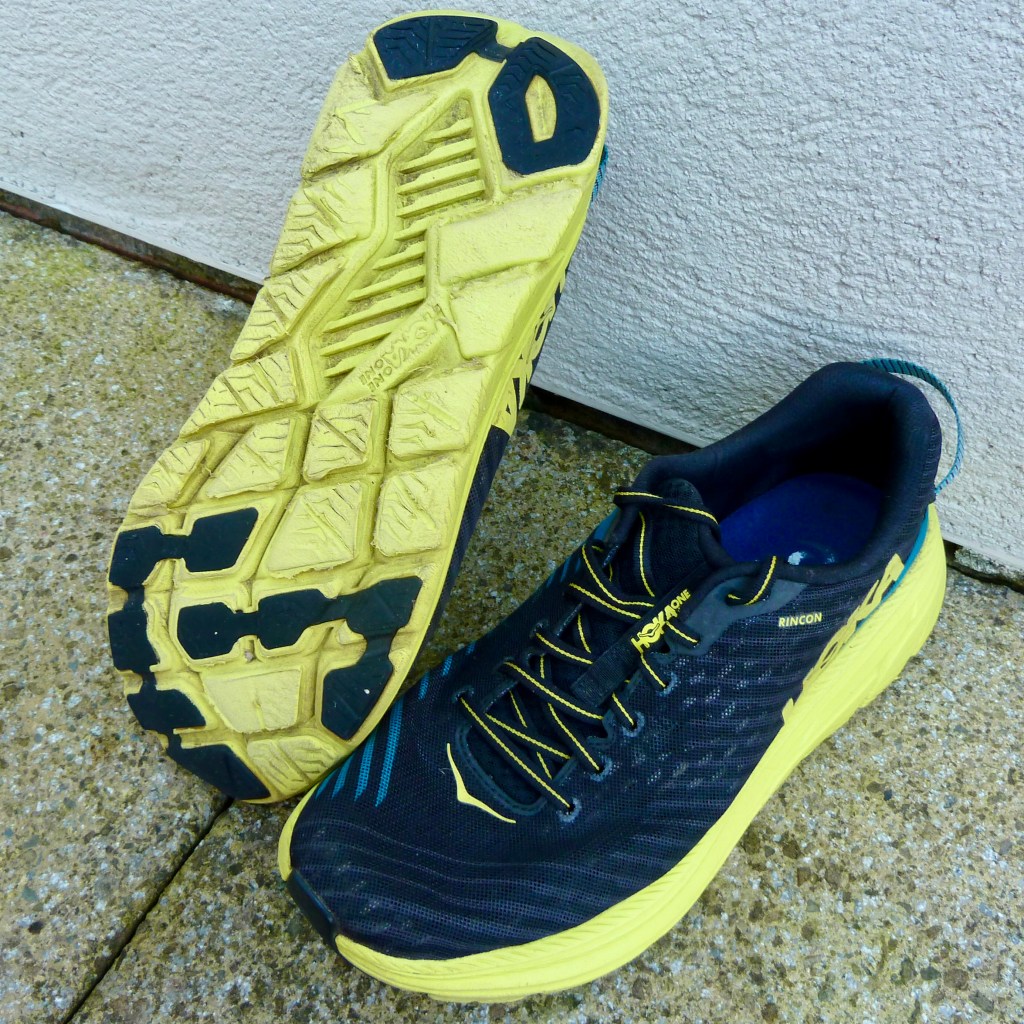
Hoka One One Rincon – 295 Miles
So a break from the Nike loving here.
This shoe was gifted to me by Hoka to use during my training for a sub 3-hour attempt at the Manchester Marathon back in April. We all know what happened to racing in 2020 but I continued to use this shoe for my tempo sessions throughout 2020.
I haven’t used this shoe for any long runs but it is a similar weight to the Turbo’s and has plenty of cushioning in that stack height so I don’t see why it couldn’t be used for a long run.
I have really enjoyed using this shoe for my tempo sessions though and have been able to hit some really challenge pace targets.
The drawback is the wear, you can see how much of the foam and rubber on the sole has worn away in half the mileage of the two pairs of Turbo shoes. That said, I have still run nearly 300 miles so it has been around the block a few times.
Race Day Shoes:
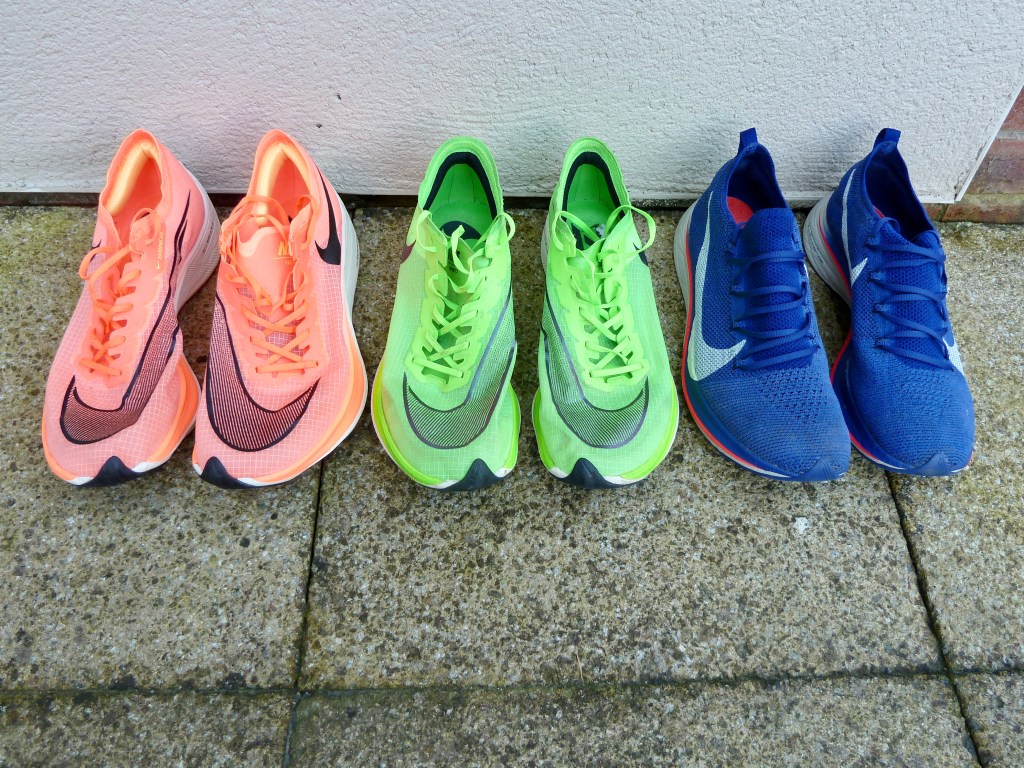
Race day shoes are a special bunch. These bad boys only get rolled out for the big day and as such only made a handful of appearances in 2020. The majority of them were during the Autumn virtual marathons.
I save my super lightweight and carbon fibre plate shoes for race day. I like to train in slightly heavier shoes without the added benefit of the carbon fibre plate. I do this so that race day feels better and I am not convinced that training with a carbon fibre plate is good for my running stride and foam.
Nike ZoomX Vaporfly 4% Flyknit – 102 Miles
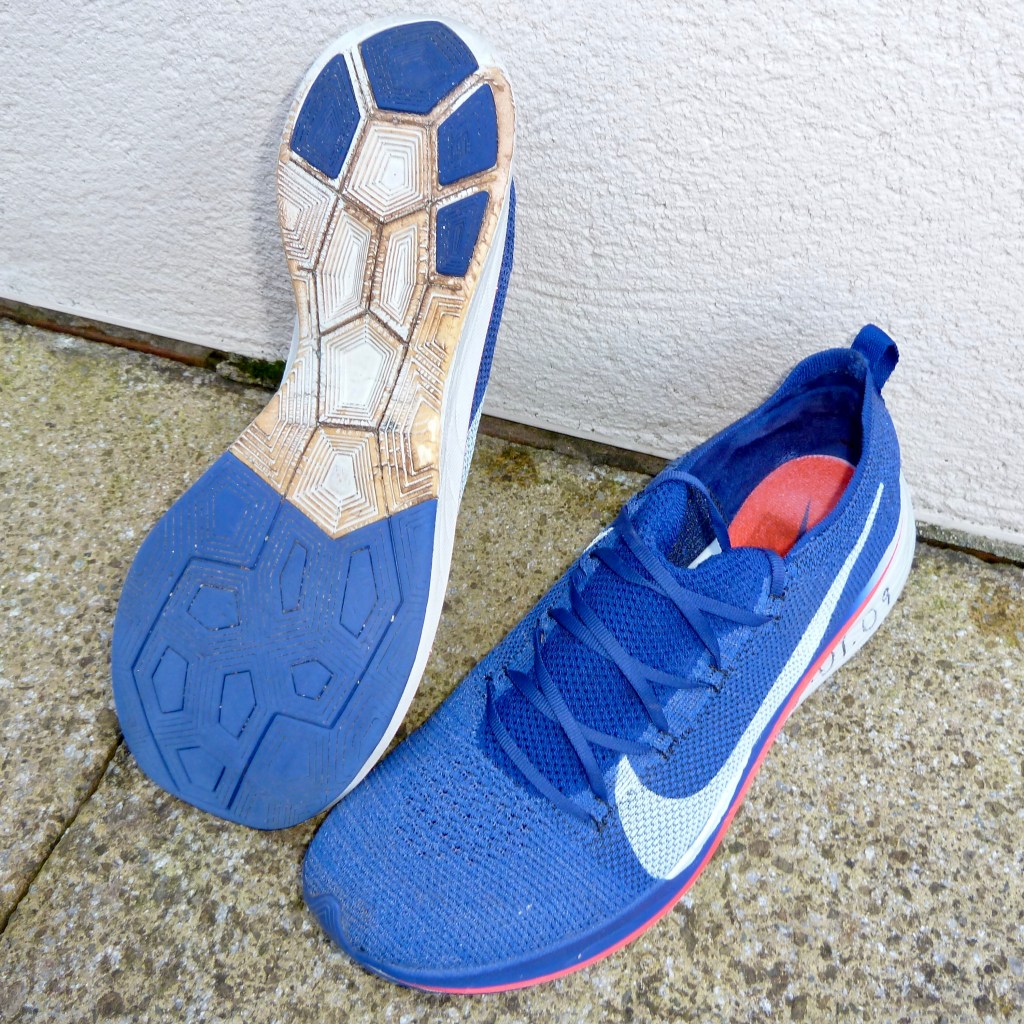
Now I really REALLY like this shoe!
I brought this shoe whilst in Chicago for the 2018 marathon but didn’t dare to try a brand new shoe out on race day so it didn’t get its first outing until Jan 2019 in a local 10k where I took over 30secs off my PB. Right from the get-go, it felt effortless, I was running a faster 10k pace than ever before but not feeling like I was pushing hard. The energy return from the carbon fibre plate in the shoe really did feel like it was pushing my feet forward.
The second time I raced in this shoe was again back at that local 10k a month later where I took a further 1min 20sec off my 10k PB. I ran the Tokyo Marathon in this shoe and WOW! yes it had the energy return and kick from the carbon fibre plate but that stack height and cushioning protected my legs so much so that they still felt fresh in the last miles and even after the race. A race where I took more than 17 minutes off my PB and run 14 minutes faster than planned.
I still love this shoe in 2020, so much so, I used it for The Big Half in March and took 3 minutes off my half marathon PB. In a 2018 shoe!
I used the 4% for my final virtual marathon in October. That stack height and comfort was the number one reason for running in the 4% over the Next% for that marathon at least. Plus I didn’t want to keep piling the miles onto the Next%’s.
Nike ZoomX Vaporfly Next% – 127 Miles

Again, another 2019 shoe that has formed part of my 2020 rotation. I loved the Vaporfly 4% as mentioned above, so the updated Next% was an obvious choice when they were released. The only downside was the price which let’s face it, is crazy but I do feel Nike has pushed the marathon running shoe market to a whole new level in terms of price but also the technology in these Vaporfly and now Alphafly shoes. A level which has left the other shoe markers standing, only now towards the end of 2020 are they starting to gain some ground…. over 2 years after Nike.
The Next% is lighter than the 4% and offers more stack height with a smaller 8mm drop and feels perfect for me.
I used this shoe for the Mid-Cheshire 5k in August and clocked a new PB. I am not 100% sure this is a 5k shoe but that energy return from the carbon fibre plate was certainly felt.
The Next% was the shoe of choice for my 2020 marathons (Manchester, Boston, Chicago and New York), sadly these did not happen but I used it for three of my four virtual marathons in Autumn, where I set my second, third and fourth fastest marathon times.
I love this shoe but it has taken until now for me to love it more than the 4%. The older 4% was the shoe I set my marathon PB in and until Autumn 2020, I hadn’t come within 16 minutes of that marathon PB in any shoe. Now I have run within 1 second of that time in the Next% I can say, this is my favourite shoe.
Nike ZoomX Vaporfly Next% – 26 Miles

Yep! another pair of Next%. I brought these in October, again, same reason as to why I brought the Turbo 2 in October. I did not want to risk not having this shoe going forward as my older 2019 pair are gaining miles.
I have heard really bad reviews of the Alphafly Next% which Nike have replaced the Vaporfly Next% within 2020. The fact that the Nike elite runners are racing in the older Vaporfly Next% and not the Alphafly says it all.
I am sticking with the Vaporfly Next% for my 2021 races, assuming I am fit enough to race in 2021 and also that racing can return.
Specialist Shoes:

So my big grand plan for 2020 was to mix things up a little and venture away from running 100% on the roads. I wanted to get out trail running once I had run the four virtual marathons in October and to race the cross country season with my running club, City of Stoke AC.
In September, I brought my first ever pair of cross country spikes and a pair of shoes which could be used on the trails and a cross country with a mixture of muddy and paved terrain.
Inov 8 X-Talon G 235 – 0 Miles
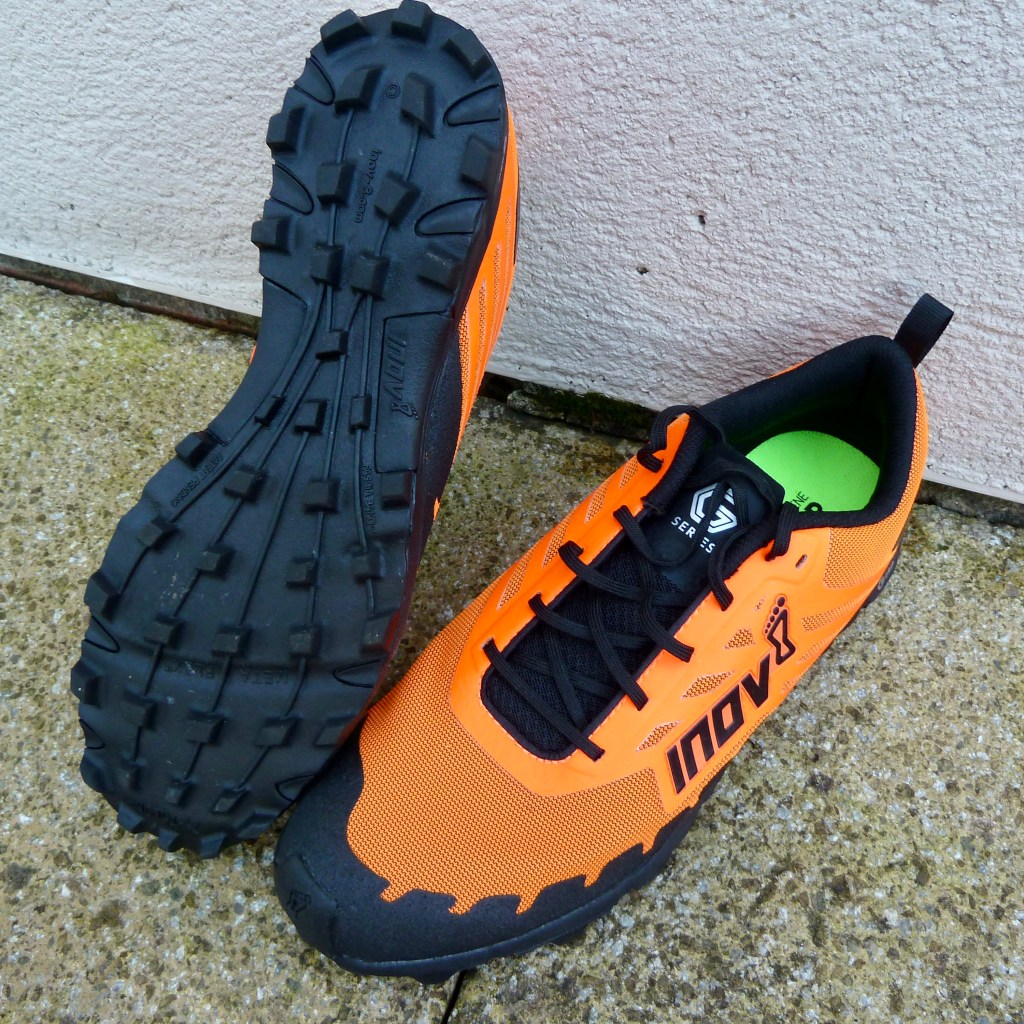
First up is my choice for the muddy/mixed terrain and trail run shoe. I haven’t had the chance to run in these yet but after a fair bit of research, I decided these were the best option to cover both options. They have 8mm lugs which should give quite good a grip in a muddy cross country session but also the ability to run on paved roads should the course have a mixture of the two.
They will also give good grip on the trails, the lugs should dig down and give a decent stable foothold.
Adidas Adizero XC Spikes – 0 Miles

For those cross country races fully on grass I have gone with the Adizero XC spikes and brought a variety of different length spikes which I can swap out depending on the conditions. Again, I haven’t had the chance to wear these as the cross country season has been cancelled and I picked up an injury anyway.
Both these are the Inov-8 will be good additions to the 2021 line up. To be fair, this is pretty much the 2021 line up I suspect.
 The Cheshire Runner.
I have seen people with large collections of shoes and couldn’t really work out the reason (I have one pair for the road – hoka awari and one for off road – walshs) but now it makes sense – so thanks! I don’t think my wife would allow me to buy any more kit though. She is still getting over the turbo I bought in September!
LikeLike
haha yes, a running shoe collection is expensive but triathlon is a whole different beast. I still need to get a TT bike. Until 2019 I used to train and race in one pair of running shoe, the Adidas Ultraboost back then, which was so heavy! Then I brought the Nike Vaporfly 4% for Tokyo and didn’t want to use up their mileage in training. That was what started my collection off. There is a guy called Seth James DeMoor on YouTube who posted a daily running vlog and often posts shoe reviews, he posts some really good and useful info on the types of shoe and their benefits, worth checking out.
LikeLiked by 1 person
Thanks will check it out. I got my TT bike on our cycle to work scheme so it’s only costing me about 60% of the full price – though you don’t get any discounts so probably only a 20% saving
LikeLike
The cycle to work scheme is great, I got my first 2 bikes on that. Really helps spreading the cost over the year and also the tax saving comes in handy too. My work only let us use it at Halfords, who don’t offer any TT bikes :o(
LikeLike
I’ve never given much thought to different shoes for different paces or races.
Another blogger mentioned different shoes for different paces last week and that was the first time I’d thought about it.
I have trail shoes that I wouldn’t use for a 5K on the streets, but they are heavier and stiffer than any other running shoes that I own. So that choice is pretty obvious.
Interesting post.
Andy
LikeLike
Thanks mate, I was the same until last year. I used to buy one pair of shoes at the start of a training block and use them for all of the training and then the race. I used to run in the Adidas Ultraboost ST but they were a heavy shoe, I have no idea how I managed to run 5 marathons and an Ironman in them carrying that weight around and lack of cushioning.
LikeLike